



 629 656

relative to the assessment of a causal link as opposed to
noncausal associations among tumor and baseline/back-
ground colonization. However, the gradual difference in
microbiome, among areas, suggests at least a noncasual
correlation; of importance, it also reduces the risk of results
due to sampling artefacts. Broader studies are mandatory to
ascertain whether the described profile is associated to,
correlated with, or even responsible for the onset of the
disease.
Due to its topography, the prostate may be reached by
members of the skin and gut microbiota, which may
eventually be able or not to survive within the particular
prostate microenvironment and outcompete other
microbes. Accordingly, the prostate prokaryotes, which
have been identified, belong to both these environments.
The high abundance of
Propionibacterium
spp., which
resulted to be composed mainly by
P. acnes
, is consistent
with the observed proinflammatory role of
P. acnes
and
supports its reported association with PCa
[13,14,24]. An
ascending urethral route is also suggested by the frequent
isolation of these species from urine
[25]. Moreover,
previous studies have reported the presence of vaginal
P.
acnes
in cultures from healthy women and patients with
vaginosis
[26] ,therefore also indicating a possible sexual
transmission.
Viceversa
, the presence of
Enterobacteriaceae
was restricted to the T samples.
Enterobacteriaceae
have
already been shown to be more abundant in other
inflammatory and neoplastic conditions
[27,28], which is
in line with a progressively increased inflammatory
environment surrounding cancer cells. Interestingly, the
higher abundance of
Corynebacteriaceae
, basically repre-
sented only by
Corynebacterium
spp
.
, in the prostate lesions
is consistent with the reported great capacity of these
species to form biofilm and adhere to extracellular matrix
components such as fibronectin, often with tissue-invasive
potential
[29]. Moreover,
Corynebacteriaceae
have also been
previously identified as potential causal agents of urinary
tract infections or urethritis
[30].
Viceversa
, the almost
exclusive presence of
Streptococcus
spp
.
in NT areas
supports the concept that this member of
Lactobacillales
may belong to the normal prostate microbiome ecosystem
and may help to maintain a physiological and beneficial
relationship with the host extracellular environment. Of
relevance, members of the
Corynebacteriaceae
family, such
as
P. acnes
and
Streptococcus
strains, are known to live and
compete in other body environments such as the skin or the
oral cavity. Inverse relationships between these strains, and
to a reduced extent with other bacteria, were observed
within the same prostate region at the genera level (data not
shown), whose significance needs to be further investigated
with methods able to identify bacteria, including
Streptococci
, at the species level.
Differences in terms of microbial environment are
expected to exist among the different zones of the prostate,
especially when comparing the transition zone versus the
peripheral zone. This may be of particular relevance when
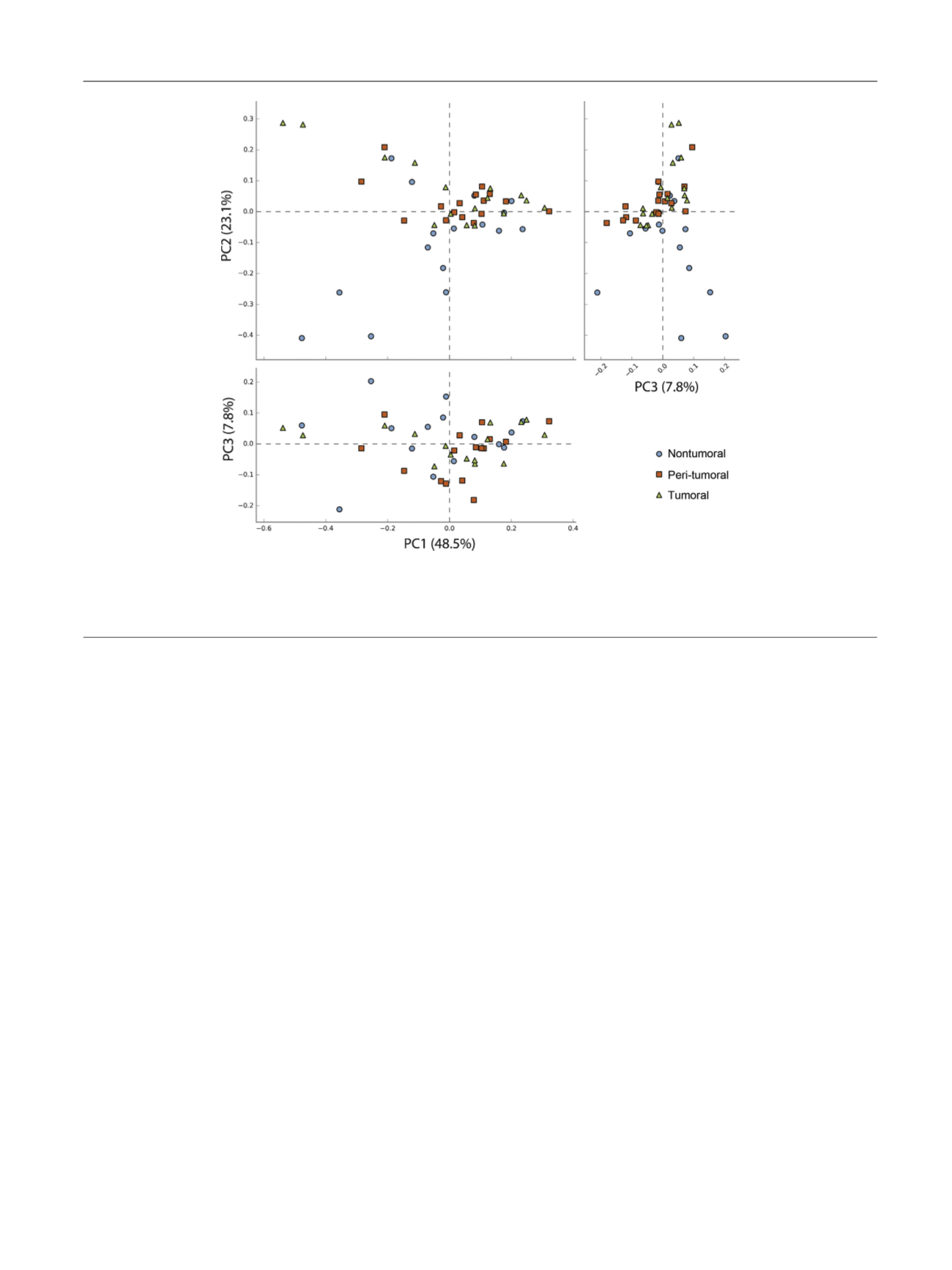
[(Fig._2)TD$FIG]
Fig. 2 – Beta diversity analysis. Principal component (PC) analysis plot of weighted UniFrac metrics for tumor (yellow dots), peri-tumor (blue dots), and
nontumor (red dots) areas of prostate samples. Multivariate analysis shows that the microbiome of the prostate is similar among the patients and that
the samples from the three prostate areas do not cluster by their overall microbiome composition. However, for some patients, nontumoral areas
appear distant from the tumor and peri-tumor samples.
E U R O P E A N U R O L O G Y 7 2 ( 2 0 1 7 ) 6 2 5 – 6 3 1
629