



 480 656

trial as recently presented, with a response rate of 27%
(22–32%); 6% of patients achieved a complete response
[14].
6.
Second-generation biomarkers
Second-generation biomarkers for predicting response to
ICIs have been explored in UC. A correlation between
mutational burden (eg, estimated using Foundation One,
which covers approximately 3% of the genome
[15]) and
outcome has been established for atezolizumab
[3]. Re-
sponse to atezolizumab also correlated with T effector gene
signatures.
Four molecular The Cancer Genome Atlas subgroups have
been identified in UC (basal and luminal types I–IV) for
which ICI activity is inconsistent. Atezolizumab appears to
be most active in the luminal type II subtype, while
nivolumab was most active in basal type I and in the
25-gene interferon-
g
signature expression
[3,11]. Basal
subtypes are characterised by overexpression of PD-L1 on
TCs and of stromal signatures. Luminal type I had low
expression of T effector signatures in the atezolizumab trial.
Further more robust data are required in this setting before
definitive conclusions can be made, particularly before we
conclude that there are differences between drugs.
7.
Future outlook
Positive randomised data for pembrolizumab in the
cisplatin-refractory setting changed the perception of other
trials in UC
[4] .Studies in the same area are likely to be
positive, and front-line trials in chemotherapy-naı¨ve
patients have a good chance of success, especially in the
biomarker-positive population
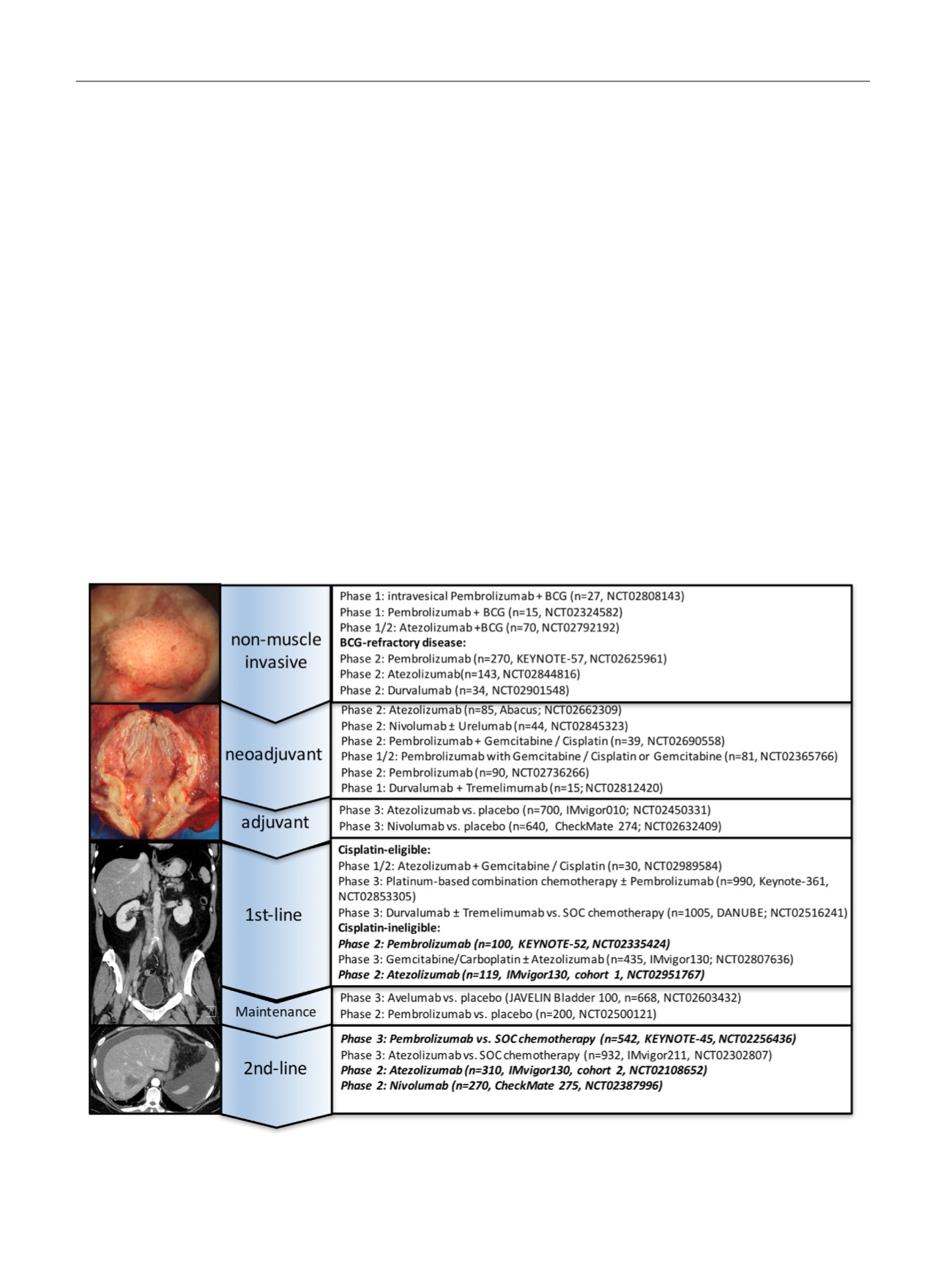
( Fig. 3). There is a novel
randomised phase 3 trial of maintenance with avelumab in
patients who have recently completed first-line chemo-
therapy for metastatic UC (NCT02603432). The hypothesis
for this approach is that early intervention in the absence of
UC progression extends survival to a greater extent than
treatment at progression.
ICIs are also under investigation in unselected chemo-
therapy-naı¨ve patients with UC. The first randomised trial
in this setting is testing chemotherapy vs. durvalumab vs.
durvalumab and tremelimumab (NCT02516241). Phase
2 data for the combinations of ipilimumab (CTLA-4)
3 mg/kg and nivolumab 1 mg/kg (
n
= 26) showed a response
rate of 38.5%, PFS of 4.3mo, and OS of 10.2mo
[16]. Owing to
inherent problems with interpretation of single-arm trials
in this setting, it is not possible to speculate if CTLA-4 and
PD-L1 combinations will be superior to single-agent ICIs.
[(Fig._3)TD$FIG]
Fig. 3 – Overview of currently ongoing immune checkpoint inhibitor trials in urothelial carcinoma in different clinical settings. Basket trials that
involve urothelial carcinoma are not listed. Trial results discussed in the main text are marked in italic and bold (clinicaltrials.gov, January 2017).
SOC = standard of care.
E U R O P E A N U R O L O G Y 7 2 ( 2 0 1 7 ) 4 7 7 – 4 8 1
480