



 E95 656

Letter to the Editor
Re: Vladimir Student Jr., Ales Vidlar, Michal Grepl, Igor
Hartmann, Eva Buresova, Vladimir Student. Advanced
Reconstruction of Vesicourethral Support (ARVUS)
during Robot-assisted Radical Prostatectomy: One-year
Functional Outcomes in a Two-group Randomised
Controlled Trial. Eur Urol
[4_TD$DIFF]
2017;71:822–30
CoRPUS and ARVUS
I would like to congratulate Student et al
[1]on their report
of exciting results of a randomised trial focused on
functional effects of a ‘‘new’’ advanced reconstruction of
vesicourethral support (
[5_TD$DIFF]
ARVUS) after robotic radical pros-
tatectomy. They demonstrated that this technique provides
significantly better results in terms of urinary continence
than the standard posterior reconstruction according to
Rocco
[2].
The authors reported that in designing this new
approach, they were inspired by the complete reconstruc-
tion of the posterior urethral support (CoRPUS) technique
we introduced as a novel approach in 2014
[3] .There are many similarities in the two techniques, such
as the use of levator ani fibres to create a posterior dynamic
support for the urethra, reproducing the effects of sling
interventions, as underlined in our original paper.
The authors confirm the clear benefits of this type of
reconstruction, but they highlight that the CoRPUS tech-
nique (rather than ARVUS) was designed for non–nerve-
sparing robotic prostatectomies. I would like to specify that
although CoRPUS was originally tested only in non-nerve-
sparing procedures to better emphasize the benefits of this
reconstruction, we usually also perform it after preservation
of neurovascular bundles.
Nevertheless, there are some caveats to be considered for
both techniques, such as the technical difficulties in
performing a posterior suspension using the levator ani
fibres when, in selected patients, a portion of the pubopro-
static ligaments are also preserved.
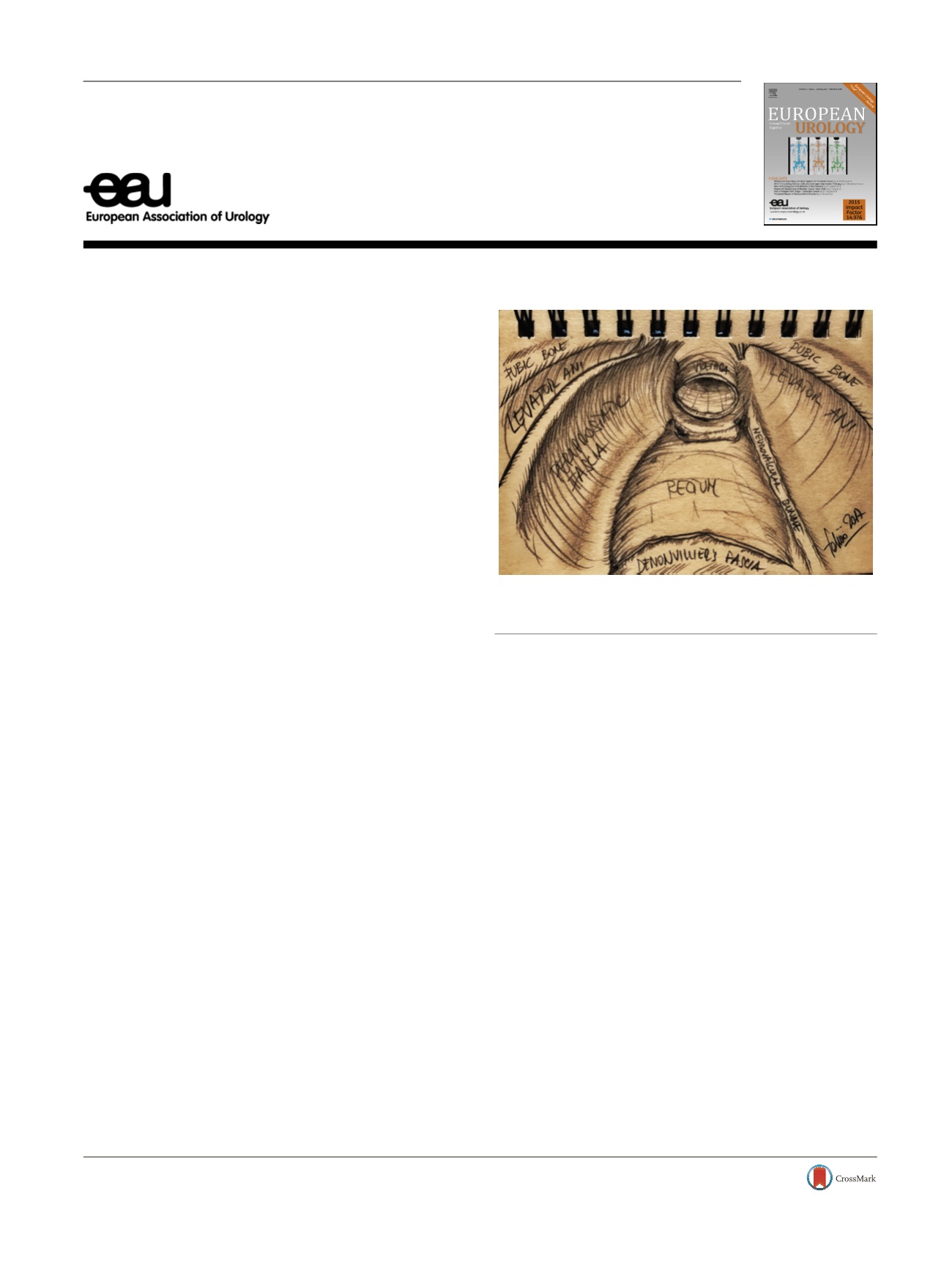
In fact, when a bilateral incision of the periprostatic
fascia is performed, medially to the puboprostatic liga-
ments, and the prostate is dissected and detached from its
‘‘envelope’’, leaving the periprostatic fascia intact, the
puboprostatic ligaments and the neurovascular bundles
are maintained as a continuous structure
[4] .In this
situation, it is extremely difficult to achieve a posterior
reconfiguration using the levator ani fibres, because their
medial approach could determine inferior traction of the
puboprostatic ligaments and neurovascular bundles, as
demonstrated in
Figure 1. In our experience, the only
reconstruction possible in these cases is the Rocco stitch
technique.
In conclusion, we confirm the feasibility of posterior
reconstruction using a CoRPUS (or ARVUS) technique in all
other cases, stressing that these approaches can also reduce
the percentage of urethrovesical anastomosis leakage, as
reported by Student et al
[6_TD$DIFF]
. [1].
Conflicts of interest:
The author has nothing to disclose.
References
[1]
Student Jr[8_TD$DIFF]
. V, Vidlar A, Grepl M, Hartmann I, Buresova E,[13_TD$DIFF]
Student V. Advanced reconstruction of vesicourethral support (ARVUS) during robot-assisted radical prostatectomy: one-year functional out- comes in a two-group randomised controlled trial. Eur Urol 2017;[14_TD$DIFF]
71:822–30.
E U R O P E A N U R O L O G Y 7 2 ( 2 0 1 7 ) e 9 5 – e 9 6ava ilable at
www.sciencedirect.comjournal homepage:
www.eu ropeanurology.com[(Fig._1)TD$FIG]
Fig. 1 – Scheme for nerve-sparing technique with (left) or without (right)
preservation of the puboprostatic ligament and prostatic fascia.
DOI of original article:
http://dx.doi.org/10.1016/j.eururo.2016.05.032.
http://dx.doi.org/10.1016/j.eururo.2017.04.0220302-2838/
#
2017 European Association of Urology. Published by Elsevier B.V. All rights reserved.